Mini Research & Essays
Bangladesh's anti-LGBTQ frenzy is an education problem
The lesson was written in the classroom. The street in Shahbagh is only giving it back.
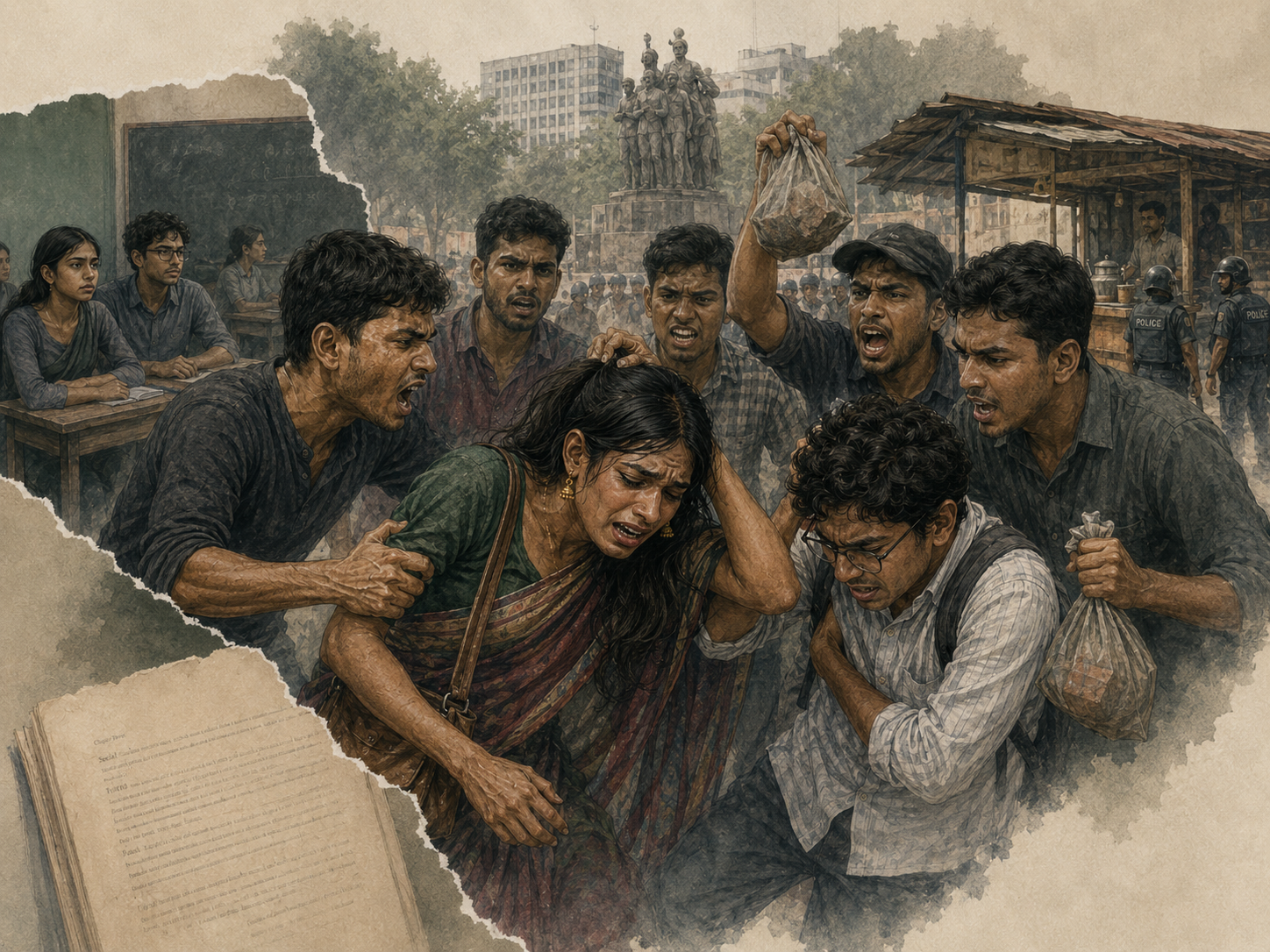
On the evening of April 10, a group of friends sat at a tea stall opposite Shahbagh Police Station in Dhaka, making plans to walk over to the Faculty of Fine Arts at Dhaka University, where preparations for Bengali New Year celebrations were underway.
Among them, as they later described in a public statement, were a hijra woman and a trans man. The group calling itself “Azadi Andolon” had been marching through Shahbagh, demanding the area be cleared of what they described as “homosexual programs.” When they spotted the group of friends, a crowd of seventy to eighty people surrounded them.
Women in the group were sexually harassed and dragged by their hair. Bags allegedly containing bricks were used as weapons. The attack sent four people to Dhaka Medical College Hospital. A complaint was filed, and police initially refused to accept it. Officers were present throughout. No arrests have been made. The attack was reported by The Business Standard, The Daily Star, and New Age.
Human Rights Watch's 2026 World Report on Bangladesh identified “religious hardliners hostile to women’s rights and to lesbian, gay, bisexual, and transgender people” as a primary driver of what it called an alarming surge in mob violence under the new government. But naming the perpetrators does not explain how they were formed.
The more uncomfortable question is not why the police failed to intervene. It is where the men who attacked learned that this was acceptable. The answer begins not on the street, but in the classroom, and in the conspicuous silence of the government now responsible for it.
The story that was erased
In January 2024, a part-time lecturer at BRAC University publicly tore pages from a Grade 7 textbook during a seminar. The pages he destroyed contained “Sharifa's Story”, a two-page narrative, included in the history and social science curriculum, about a third-gender individual navigating identity and community. The story did not advocate for any political position. It asked young Bangladeshis to understand that people different from them exist and deserve recognition.
The act of destruction was filmed, went viral, and triggered something the story itself never could: a national mobilisation. Within days, legal notices were filed, protests spread to university campuses, and the Education Ministry convened a five-member expert committee to review the story’s inclusion. The committee was chaired by the vice-chancellor of Islamic Arabic University and included a member of the Islamic Foundation.
By June 2024, the Ministry had removed “Sharifa's Story” from the curriculum. The NCTB chairman's explanation was unadorned: “As the story drew a lot of debates, the decision to remove it was taken.”
The story was removed under the Hasina government. Then, in January 2025, the interim government reverted entirely to the 2012 curriculum, the curriculum that predated “Sharifa's Story” altogether. Bangladesh's entire political establishment, across three governments, has arrived at the same pedagogical conclusion: this child does not belong in the classroom.
When a curriculum teaches erasure, the street becomes the exam.
The structural chasm
The problem runs through Bangladesh's education system at far greater scale than one removed story. According to government data, there are currently 2.75 million students enrolled in Alia madrasas alone, a figure that has grown by more than 250,000 in four years, even as secondary school enrollment fell by over one million students during the same period. When Qawmi madrasas, privately funded, largely unregistered, and exempt from NCTB oversight, are counted alongside them, the proportion of children receiving religious education outside state curriculum oversight is substantially larger still.
In Qawmi madrasas, the curriculum is governed not by the NCTB but by clerical authority and conservative Islamic scholarly networks. Gender non-conformity is not merely absent from these curricula. It is actively framed as sinful, unnatural, and a threat to moral order.
Students spend years in environments where the existence of a transgender person is either invisible or condemned. When they encounter those people on the street, at a tea stall in Shahbagh, at a Bengali New Year celebration, they have been given no language for recognition, no framework for coexistence. They have been given, instead, a theology of rejection.
The men who attacked in Shahbagh were not, in any simple sense, uneducated. They were products of a system. And now, critically, the BNP government's own election manifesto pledges to recognise Qawmi madrasa certificates and give their graduates priority in government jobs, a gesture of political accommodation with no appetite for examining what those institutions teach.
A pattern, not a coincidence
The Shahbagh attack is not isolated. JusticeMakers Bangladesh in France, the only organisation systematically monitoring LGBTQ+ violence in Bangladesh, documented 426 individuals affected across 260 incidents in 2025, up from 396 in 2024, 219 in 2023, and 204 in 2022. Transgender and gender-diverse individuals were the most frequently targeted. The trajectory is not ambiguous.
In September 2025, twelve hijra people were arrested in Narayanganj while collecting money from vehicles, a traditional livelihood practice, on allegations of extortion. In November 2025, a chemistry professor at Dhaka University was arrested following a campaign by pro-Islamist students who, according to LGBTQ advocacy groups, targeted him because of his sexual identity.
In August 2025, Sahara Chowdhury, a transgender final-year English student at Metropolitan University in Sylhet, was expelled for life after sharing a satirical post online, involving the same lecturer who had torn the textbook pages the year before. The trans scholarship quota at the University of Dhaka was abolished with no consultation and no transition support.
JMBF’s report identifies the perpetrators with precision: law enforcement personnel, organised local groups, religiously motivated actors, educational institutions, family members, and community leaders. “Political engagement with LGBTQI+ rights remains extremely limited,” the report concludes. “Most political parties either avoid addressing issues related to sexual orientation and gender identity or openly oppose legal recognition and protection.”
These are not coincidences. They form a system. And systems have origins.
The minister and the missing question
Into this landscape, Bangladesh's new education minister has arrived with a clear set of priorities. ANM Ehsanul Hoque Milon, appointed under Prime Minister Tarique Rahman's BNP government, returned to the education portfolio he last held from 2001 to 2006. In February, the ministry unveiled a 12-point reform agenda covering skill-based education, digital classrooms, technical training, and examination integrity. Experts have welcomed parts of the agenda while noting that discrete actions on individual objectives risk being “a false remedy for a symptom of a disease rather than for the disease itself.”
Then, on April 23, thirteen days after the Shahbagh attack, Milon told parliament that schools would institutionalise “ethics education” to “foster moral and religious values.” In the context of a curriculum from which “Sharifa's Story” has just been removed under Islamist pressure, this phrase is not neutral administrative language. It is a policy direction.
Nowhere in the minister's statement, or in the 12-point agenda, is there any mention of inclusive curriculum, civic recognition of minority communities, or the pedagogical conditions that produce dehumanisation.
Honesty in examination halls matters. But it is a narrow conception of what education is for. A student who passes their SSC without cheating but has never been taught to recognise the humanity of someone different from them has been only partially educated. The part that is missing is not detectable by any invigilator with a CCTV camera.
The policy argument that requires no political courage
There is a policy argument here that does not require any government to take a formal position on LGBTQ rights. It requires only the recognition that a curriculum which excludes minority communities produces citizens who do not recognise the humanity of those communities, and that non-recognition, in conditions of political polarisation and impunity, becomes violence.
This is among the most robust findings in the sociology of prejudice: contact with difference, including narrative contact through education, is one of the few reliably effective interventions against dehumanisation.
As Professor Tarique Ahsan of Dhaka University's Institute of Education and Research said at the time of the Sharifa controversy: the story “was included to help society think positively, but a section of society cannot get out of their old mentality.” The ministry that removed the story understood the same mechanism and made the opposite choice.
The regional dimension is instructive. In India, Pakistan, and Sri Lanka, debates over inclusive curriculum content have played out in strikingly similar sequence: organised religious pressure, state capitulation, the erasure of minority communities from textbooks, and the subsequent normalisation of violence against those communities in public space. Bangladesh is not exceptional; it is representative of a pattern in which educational erasure functions as a precondition for street-level dehumanisation.
The BNP presents itself as the more liberal of Bangladesh's two dominant political forces. It came to power on the back of a youth uprising that demanded a different country. Its government commands a two-thirds majority in parliament. No structural obstacle stands between it and educational reform. The question is whether it has the political will to use that majority for something more ambitious than clean exam centres and “moral and religious values.”
Will Prime Minister Tarique Rahman's government restore “Sharifa's Story,” or something like it, to the curriculum? Will it reinstate the trans scholarship quota at Dhaka University? Will it direct serious resources toward civic education in a system where millions of students currently receive their moral formation from institutions that treat tolerance as a foreign concept?
Or will it, as its manifesto's promise to give Qawmi graduates job priority suggests, continue to accommodate the Islamist street while governing the liberal centre?
The lesson was written in the classroom. The street in Shahbagh is only giving it back. Whether the next lesson is different depends, in large part, on choices being made in Dhaka right now.
Miraz Hossain is a journalist based in Dhaka. He covers politics, governance, and human rights for The Business Standard and Netra News. He is a researcher and BSS candidate at the University of Liberal Arts Bangladesh, where he also teaches Academic English.